



Article by
Kim Davis
Kim Davis is the founder and designer of Grace Blooms Jewelry and Roma Designer Jewelry.
For nearly two decades, Kim has been a tireless advocate for jewelry solutions focused on ease of use. Her own struggles with finger dexterity and pain make this a cause near and dear to her heart.
With millions of adjustable chains sold to happy customers around the world, Kim has become one of the world's foremost experts on jewelry focused on ease of use and accessibility.
Stainless steel usually won’t turn your skin green. If you’re wondering whether stainless steel jewelry will turn your skin green, the short answer is usually no, especially with 316L stainless steel. Green marks are more often caused by copper reacting with moisture, sweat, or products on your skin.
A green or black mark can make you wonder what’s happening to your jewelry. A mark doesn’t automatically mean the steel is breaking down. Sweat and residue from lotions or perfume can contribute, and black marks are often buildup on the skin rather than rust.
I’ll walk you through what causes green and black marks, how to wash them off, and how sweat and skin products can affect discoloration. I’ll also explain why 316L stainless steel is less likely to leave a green mark, what to do if a piece irritates your skin, and how simple cleaning habits can help keep your jewelry looking fresh.
Key Takeaways
- Green marks often point to copper in a jewelry alloy, while black marks can come from residue on the skin.
- Sweat, lotions, and perfume can contribute to discoloration. Simple cleaning and drying habits can help reduce buildup.
- 316L stainless steel is generally unlikely to leave green marks, but irritation is a separate concern for people with nickel allergies.
- Learn how to clean jewelry gently and recognize when a mark may be linked to a product or finish.
- An adjustable chain offers a practical next step when you want flexibility in how you wear your jewelry.
Can Stainless Steel Turn Skin Black?
I look for a black mark or rust before drawing conclusions. Black marks from jewelry are usually residue, not corrosion. Lotions, sunscreen, perfume, and friction can leave dark material beneath a ring or chain. Skin oils and sweat can mix with that buildup. If the mark wipes away, that’s a useful clue.
Here’s why I say stainless steel behaves differently from copper-based metals. It’s made primarily of iron and chromium, and some grades also contain nickel. 316L stainless steel contains 16-18% chromium and 2-3% molybdenum, along with roughly 10-14% nickel. Stainless steel’s passive film forms in oxidizing environments when chromium content is at least about 10.5%. That thin protective layer helps resist corrosion.
I also find it helpful to know what happens when the surface gets scratched. The chromium-rich protective layer is only a few atoms thick, yet it can rebuild within hours when exposed to air. That helps explain why 316L resists everyday corrosion. Sweat contains moisture and salts, though, so deposits can still collect where jewelry rests against skin. I rinse the piece after wear and dry it with a soft cloth.
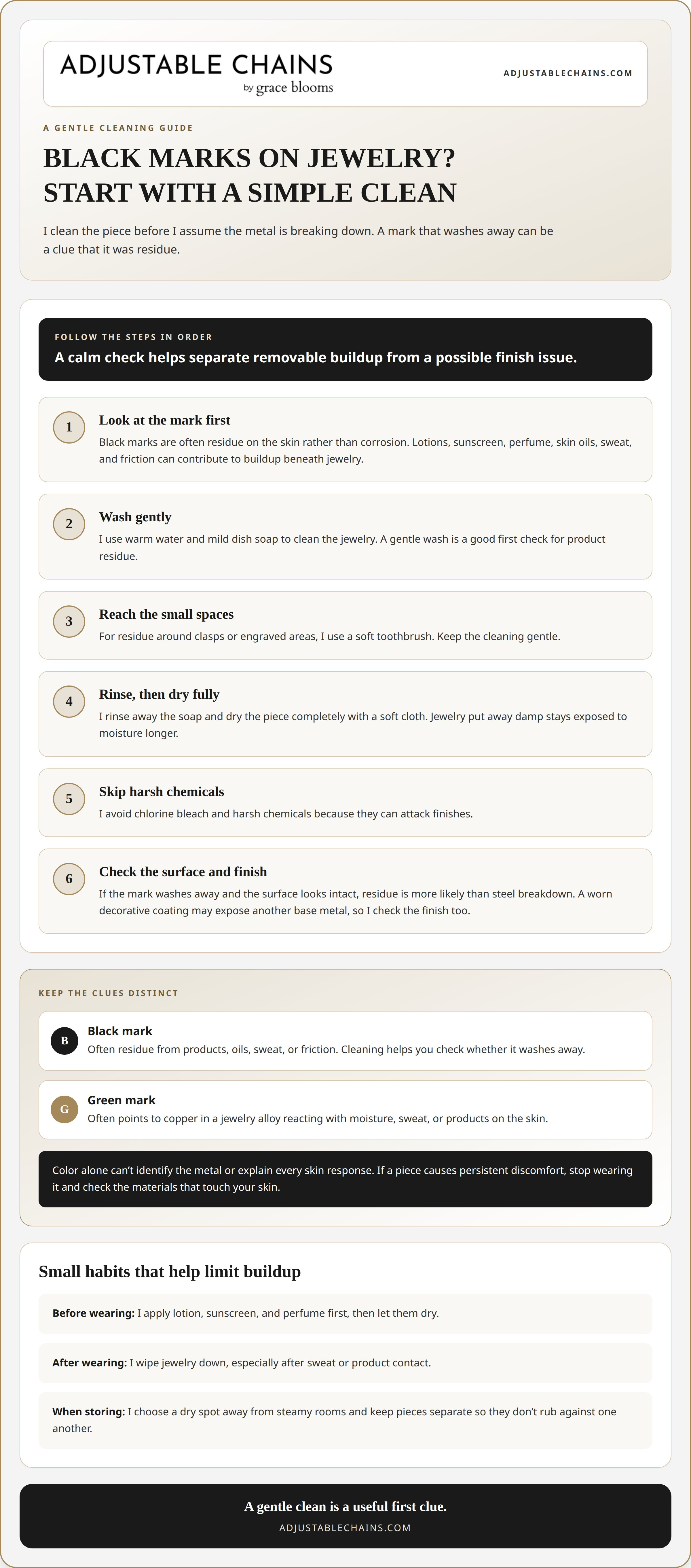
If I notice a black smudge, I clean the jewelry before assuming the steel is rusting. I use warm water and mild dish soap. A soft toothbrush can reach residue around clasps or engraved areas. I rinse well and dry fully. I avoid chlorine bleach and harsh chemicals, which can attack finishes. If the mark washes away and the surface looks intact, residue is more likely than steel breakdown.
I also consider whether the jewelry has plating or a decorative coating. A worn finish may expose another base metal, while product buildup can collect on plated or uncoated pieces. Hand cream beneath a ring, for example, can leave residue along its underside. I remove rings before applying heavy cream, then wipe the jewelry after wearing it. These steps help me distinguish removable buildup from a finish issue.
What Actually Turns Skin Green?
I look at two separate clues: the jewelry’s material and how your skin responds. A metal label describes what the jewelry is made of, while a mark or reaction shows what happened during wear.
Nickel Release and Allergy Considerations
Nickel release means nickel moves from a jewelry surface onto skin. The nickel content of an alloy and the amount released aren’t the same measurement. For example, a 316L label describes the steel grade, but it doesn’t tell me how every finished component behaves. Coatings, surface wear, and clasp construction can all matter when I’m assessing a particular piece.
I look at the entire piece, not just the main chain. A necklace may combine a steel chain, a separate clasp, and a decorative finish, and those parts can use different materials. If you have a nickel allergy, a broad label such as “stainless steel” may not give you enough detail about the jewelry’s components.
Green Stains Versus Metal Allergies
I think of a stain and an allergy concern as different kinds of evidence. A stain is a visible change on the skin; an allergy involves a response to contact with a material. Color alone can’t tell me which metal is involved or what your skin is reacting to. I consider the jewelry’s construction alongside what you notice after wearing it.
For a practical comparison, I inspect a clean-looking chain, its clasp, and any plated details. If only one component touches the affected area, that contact point can help narrow down what to examine. I find a product description naming the base metal and finish more useful than a color name such as “silver tone.”
If you have a known nickel sensitivity, I’d look for a clear nickel-free materials description rather than rely on appearance. A silver-colored finish doesn’t identify the metal underneath, and “hypoallergenic” doesn’t name every component. Use the material details to guide your choice, and stop wearing a piece that causes persistent discomfort.
The key point I want to share about green marks is that skin color alone doesn’t identify the jewelry’s grade or the cause. Use the mark as a reason to inspect the finish and the materials touching that area. I keep the questions distinct: a visible stain concerns discoloration, while a diagnosed nickel allergy makes the alloy and all contacting components relevant.
How sweat, humidity, and skin chemistry affect discoloration
I think of exposure as a pattern, not a single moment. A bracelet worn through a humid afternoon has longer contact with damp skin than a necklace removed after dinner. The area beneath a close-fitting clasp or stacked bangles may stay warm and damp, so I’d check those contact points after a long day.
Daily wear changes the conditions around jewelry. A ring worn while gardening, cooking, or exercising meets more friction and skin products than a piece saved for occasional outings. Friction matters for plated finishes, too. A piece worn through activities that rub against its surface may show different wear from one protected from repeated contact.
Skin chemistry varies, too. The same bracelet may leave a mark after a warm walk but not after a short indoor gathering. That doesn’t mean the metal changed. It shows how wear time, moisture, and substances on the skin combine. I’d note what I was doing and where the jewelry sat before drawing conclusions from one occasion.
Humidity affects more than the skin beneath a piece. Jewelry kept in a damp bathroom or put away before it’s fully dry stays exposed to moisture longer. I’d choose a dry storage spot away from steamy rooms and store pieces separately so chains and bracelets don’t rub against one another.
Timing cosmetics can limit contact with lotions, sunscreen, and perfume. I apply them first, let them dry, then put on my jewelry. A bracelet worn immediately after sunscreen application, for example, may pick up product along its underside. I take it off before applying more lotion to keep fresh product away from the metal.
I compare how the same piece behaves in different settings. I wear it for a short indoor occasion, then notice whether the result changes after exercise or humid weather. This can help me identify whether prolonged contact or a particular product is involved. I avoid changing several parts of my routine at once, so I can pinpoint the factor that matters most.
If a piece is plated, I inspect its finish during regular wear. A change in color or a rough patch may indicate wear, especially where a clasp or bracelet repeatedly touches a desk or sleeve. Changing how and when I wear it may reduce friction. If skin discomfort persists, I stop wearing the piece rather than treating the issue as ordinary discoloration.
Whether 316L stainless steel jewelry turns skin green
With sweat, water, or lotions, 316L stainless steel usually won’t turn skin green. Moisture and products can leave residue, while worn plating may expose a copper-containing base metal.
316L Jewelry Under Everyday Exposure
316L stainless steel usually resists corrosion during ordinary wear, so its surface is unlikely to create a green mark. Its chromium-rich protective layer helps keep the metal stable around skin and moisture. That makes 316L a practical choice for a bracelet worn through regular activities. A green stain can still happen if the jewelry is plated over another metal or collects residue.
Effects of Sweat, Water, and Lotions
Sweat and water can leave moisture on a bracelet, but they don’t turn 316L steel into copper. Lotions and sunscreen may cling to the surface and mix with skin oils. If the piece has a worn coating, exposure to its base metal can change the outcome. Dry jewelry after washing or exercise, then wipe away visible product buildup.
Examine the mark and the jewelry together. If the green color washes off and the steel surface looks intact, residue or contact with another metal may explain it. If the finish looks worn, a different base metal could be touching your skin. For example, a gold-tone plated bracelet may reveal its underlying alloy as the coating wears.
Humidity can keep moisture between jewelry and skin for longer. A snug ring or bracelet may hold sweat and lotion in crevices, especially on a warm day. Rinse away product residue with mild soap and water, then dry the piece fully. Avoid bleach and harsh cleaners, which can damage finishes and complicate the issue.
Persistent redness, itching, or bumps call for a different response than a temporary green mark. Nickel can be present in 316L steel, and some people are sensitive to it. Stop wearing the piece if irritation continues, rather than treating the skin as stained. A green mark alone doesn’t establish a nickel allergy.
For the reader asking whether 316L stainless steel jewelry turns skin green, the practical answer is usually no. Sweat, water, and lotions can leave deposits, but the steel itself is not a typical source of copper salts. Check for worn plating, clean gently, and notice whether discoloration returns or irritation appears.
Which stainless steel grades are used in jewelry, such as 304 and 316L?
When I look at stainless steel jewelry, I keep in mind that it can use different grades, and the grade helps describe its composition. 304 and 316L are austenitic stainless steels, while 201 and 409 use different metal formulations. Knowing the grade gives me more context than a general “stainless steel” label, especially when I’m comparing pieces for daily wear.
316L contains 16-18% chromium and 2-3% molybdenum. Chromium helps form a protective surface film, and molybdenum adds another element to the alloy. 316L also contains roughly 10-14% nickel, so I pay attention to its grade when nickel sensitivity is a concern. Jewelry listings may also call it “surgical steel,” though that label alone doesn’t explain every detail of the piece.
Grade 304 is another austenitic stainless steel used in jewelry. Both 304 and 316L are weakly magnetic or not magnetic at all. I don’t rely on a magnet test to identify either grade, since it can’t reliably prove the composition. The label and the information provided for the specific piece are more useful starting points.
Grades 201 and 409 use less chromium and more filler metal than the grades described as higher quality in the available material. Since chromium helps stainless steel resist corrosion, I consider how the grade may affect the surface’s ability to stand up to exposure. Still, a grade label doesn’t reveal whether a separate coating or plating covers the jewelry.
This distinction matters if a piece leaves a green mark. Stainless steel itself isn’t the usual source of copper salts, but plated jewelry may have another base metal beneath its finish. If the coating wears, that underlying metal may contact your skin. I keep in mind that a grade listed for a piece describes the steel, not necessarily every layer or component in a finished bracelet.
For a practical comparison, I look for the exact grade rather than relying only on terms such as “steel” or “surgical.” Then I consider the finish and whether the item is plated. 316L’s chromium and molybdenum content helps explain its corrosion resistance, but I wouldn’t use a grade label to identify the cause of every skin mark. Residue, a worn finish, or another metal in the piece may also matter.
An Adjustable Chain as Your Next Step
I make adjustable chains at Grace Blooms for women who want to change how a necklace sits without switching between fixed lengths. One chain can work with different necklines, pendants, or outfits. The sliding adjustment changes the fit, but it doesn’t change the metal’s composition or guarantee that a piece will never leave a mark.
Each chain uses a patented adjusting gasket that slides along the chain. Chains 24 inches and longer slip over your head with the lobster clasp closed. Then you slide the gasket to set the necklace at 14, 16, 18, or 20 inches. The clasp still lets you change pendants and charms, so you can adjust the fit without opening it to get dressed.
One adjustable chain replaces four fixed chains at 14, 18, 20, and 24 inches. I think that can make getting dressed simpler if your hands don’t cooperate the way they used to. Instead of managing a small clasp behind your neck, you can put the longer chain over your head, then move the adjusting gasket to the length you want.
Material details matter if you’re choosing jewelry with skin sensitivity in mind. Our chains are mostly brass with a real 18K gold or rhodium finish. Some use a stainless steel base, and others use a sterling silver base. Every chain is hypoallergenic and nickel-free. The exact base metal can vary, so I wouldn’t assume every adjustable chain is stainless steel.
That distinction matters when you’re considering discoloration. An adjustable length can help you wear a necklace comfortably, but it doesn’t prevent residue or reactions related to metal, moisture, or products on your skin. If irritation continues, stop wearing the piece. If your main frustration is putting on or adjusting a necklace, the sliding gasket lets you change the fit yourself.
You can also choose adjustable bracelets, necklace extenders, or anklets when you want a flexible fit beyond a necklace. An adjustable bracelet, for example, lets you change its position on your wrist rather than choosing among fixed lengths. Think about the jewelry you wear most, then consider which adjustable style might make it easier to wear.
Explore adjustable chains from Adjustable Chains by Grace Blooms to find a flexible necklace option.
Frequently Asked Questions
Does stainless steel contain nickel, and will it cause a reaction?
Some stainless steel grades contain nickel, but I wouldn’t assume its presence alone means you’ll react. 316L stainless steel contains roughly 10-14% nickel. Sensitivity varies, and a reaction depends on skin contact and nickel release from the finished piece. When I compare jewelry, I look for the stated grade and whether it has a coating. A material label gives useful context, but it can’t predict your personal response.
Final Verdict: Should You Worry?
I’d think of a green mark from jewelry as usually temporary, while ongoing redness or itching deserves more attention. I’d start by washing the mark and examining the jewelry’s finish. If the color returns in the same spot, I’d note whether the piece is plated or shows wear. If your skin remains irritated after you stop wearing it, I’d seek medical advice rather than treating it as a simple stain.
How can I tell if a piece is solid stainless steel before I buy it?
I look for the grade and a clear description of the jewelry’s material layers. “316L stainless steel” identifies a grade, while “gold-plated stainless steel” describes a steel base with a colored surface finish. Those labels mean different things. I wouldn’t rely on a magnet test to confirm the grade because 304 and 316L can be weakly magnetic or not magnetic at all.
So, What’s Actually Happening?
I think of a mark as possibly coming from a reaction at the metal’s surface or from material that has built up on the jewelry. Friction can rub residue from a ring onto skin, for example, while copper in an exposed alloy can leave a green color. The mark’s appearance is only one clue. I’d also consider whether it washes off, returns, or comes with persistent irritation to help distinguish possible causes.
Which Metals Cause Skin Discoloration?
I most often associate green marks with copper-containing metals. Brass, bronze, some lower-karat gold alloys, and the base metal beneath worn plating can contain copper. Sterling silver may also tarnish, a surface change caused by exposure to air. I’d check whether the jewelry is a solid alloy or plated, since a worn finish can reveal a different metal underneath.
Does stainless steel jewelry turn skin green?
Stainless steel itself usually doesn’t leave a green mark. If you’re wondering whether stainless steel jewelry will turn your skin green, I’d look for copper-containing metal beneath worn plating or residue from products on the piece. A stain that washes away can help narrow down the cause. I’d treat persistent redness or itching as a different concern than color alone.
What causes skin to turn green from jewelry?
Green color usually forms when copper reacts with moisture, sweat, lotions, or natural skin acids. The reaction creates copper salts that can transfer onto the skin. For example, say you have a gold-colored ring with a worn finish: it may expose a copper-containing base alloy. Washing the area with soap and water removes the temporary mark, though the same jewelry may leave it again.
Can nickel in stainless steel jewelry cause skin irritation or allergic reactions?
Yes. I’d consider nickel in stainless steel relevant for someone with a nickel allergy, though the grade’s nickel content doesn’t show how much releases onto the skin. Redness, itching, or bumps differ from a green stain and can indicate irritation. If you know you’re sensitive to nickel, I’d choose jewelry labeled nickel-free and stop wearing any piece that triggers a reaction.
Disclaimer
*About magnetic clasps: Magnets can interfere with implanted cardiac devices. If you have a pacemaker or an ICD, choose an adjustable chain that you can slip over your head rather than a magnetic clasp.


